Pay
Pay is compensation for work.
On this page, you’ll find answers to questions such as:
Your pay is agreed in the employment contract. You should always have a written employment contract. Read more.
There is no statutory minimum wage in Finland, which is why collective agreements in different sectors have provisions on minimum wages. Read more.
A pay slip tells you your gross pay, the deductions made from it, as well as the net pay that will be paid to your bank account after deductions. Always check your payslip carefully. Read more.
If your pay isn’t enough to live on, you can apply for and receive support from Kela. Read more.
Request the correct pay in writing from your employer. If they still won’t pay you the appropriate amount, contact the shop steward or union representative at your workplace or your trade union. Read more.
Pay
It’s important to agree on the amount of pay when entering into an employment contract. You should always have a written employment contract.
There is no statutory minimum wage in Finland, which is why collective agreements in different sectors have provisions on minimum wages. Your salary must not be less than the minimum wage.
‘Minimum wage’ refers to the minimum amount that you should receive for your work. If there is no collective agreement for the industry you work in, your pay must still be reasonable. ‘Reasonable’ means that you should receive the same level of pay that is usually paid for other tasks similar to yours.
A variety of pay supplements also exist. Supplements are compensation paid in addition to your basic pay. You can be paid an evening work supplement, night work supplement, Saturday work supplement or a Sunday work supplement, for example. As an example, for work done on a Sunday, you receive 100 per cent more pay. This means your pay is doubled, unless otherwise agreed in the relevant collective agreement.
Wages must be paid to the bank account provided by the employee.
Monthly salary
If you have a monthly salary, you will be paid once a month. The pay period will then be one month. The pay period refers to the period for which you are paid a salary at a time.
Hourly wage
If you are paid by the hour, you will be paid every two weeks. Hourly wages are paid according to how many hours you have worked.
Payslip
When you receive pay, you must always receive a payslip as well. A payslip has many names in Finnish; it can be called a palkkalaskelma, palkkakuitti, palkkatodistus, palkkanauha or tilinauha. The payslip details how much you have been paid, what deductions have been made from your gross pay, and how much money will be paid to your account, i.e. your net pay.
Every time you receive pay, you pay taxes and other statutory payments. This means that the pay you receive into your account will not quite be the full amount of wages agreed in your employment contract.
Always check your payslip carefully!
Model payslip in Finnish
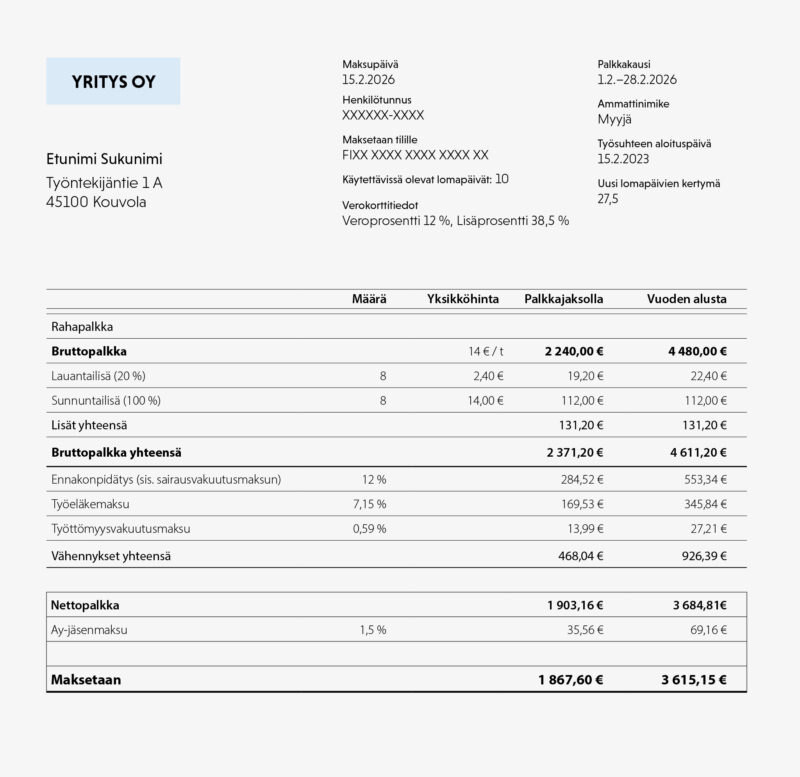
Payroll legend translations
Maksupäivä
Payment date
Henkilötunnus
Personal identity code
Maksetaan tilille
Paid to account
Käytettävissä olevat lomapäivät:
Leave days available:
Verokorttitiedot
Tax card information
Veroprosentti
Tax rate
Lisäprosentti
Additional withholding
Palkkakausi
Pay period
Ammattinimike
Job title
Työsuhteen aloituspäivä
Start date of employment
Uusi lomapäivien kertymä
New accrual of leave days
Määrä
Quantity
Yksikköhinta
Unit price
Palkkajaksolla
During the pay period
Vuoden alusta
From the beginning of the year
€/t (euroa tunnissa)
€/t (euros per hour)
Rahapalkka
Cash pay
Bruttopalkka
Gross pay
Lauantailisä
Saturday allowance
Sunnuntailisä
Sunday allowance
Lisät yhteensä
Total allowances
Bruttopalkka yhteensä
Total gross salary
Ennakonpidätys (sis. sairasvakuutusmaksun)
Withholding tax (incl. health insurance contribution)
Työeläkemaksu
Earnings-related pension contribution
Työttömyysvakuutusmaksu
Unemployment insurance contribution
Vähennykset yhteensä
Total deductions
Nettopalkka
Net pay
Ay-jäsenmaksu
Trade union membership fee
Maksetaan
To be paid
Payslip must include at least the following information:
- Name of employer
- Name of employee (your name)
- Pay period: the period for which the pay is paid
- Payment date: the day on which the pay must be paid to your account
- Your gross pay (if you are paid by the hour, the hourly rate must also be indicated). The gross pay is the amount agreed in your employment contract. For example, taxes have not been deducted from that.
- Supplements:
- Overtime: if you have worked more than your normal working hours and your collective agreement has provisions on an additional amount or compensation for overtime, you will receive overtime compensation.
- Compensation for evening work, night work, Saturdays, Sundays, and public holidays: if you have worked in the evenings, at night, on Saturdays, Sundays, or public holidays, you are entitled to an evening, night, Saturday, or Sunday supplement for your work if these have been agreed in your collective agreement or by law. As an example, for work done on a Sunday, you will receive double pay (100% more than on a regular working day), unless otherwise agreed in your collective agreement.
- Income tax is paid on supplements as well.
- Fringe benefits: Fringe benefits are pay that is paid as a monetary compensation or a non-monetary compensation. For example, a phone given to you by your employer can be a fringe benefit if you do not need to pay for using it. A fringe benefit can also be a lunch benefit, a sports benefit or a car. Income tax is also withheld for fringe benefits.
- Deductions from your pay:
- Withholding tax, or income tax: your personal tax card indicates the percentage of income tax withheld from your pay. Your employer will either receive your tax card directly from the Tax Administration or ask you to submit it to them.
- Pension insurance contribution: your pension starts accruing when you turn 17, and your pension insurance contribution will be deducted from your pay.
- Unemployment insurance contribution
- Health insurance daily allowance contribution (not deducted if your annual income is low)
- Other possible deductions: e.g. trade union membership fee, if you are a union member, and you have agreed that your employer will calculate and pay the membership fee directly from your pay.
When your employment ends, your employer must pay you your final pay immediately, unless you have agreed otherwise with your employer in a contract or elsewhere. If you have accrued annual holiday days during your employment that you have not used, you must receive them as money with your final pay as holiday pay. Annual holiday compensation is also included in the final pay.
Sufficiency of pay
If you are a student, a part-time worker or have a zero-hour employment contract, your pay may not be enough to live on. You can apply for and receive support from Kela.
Housing allowance
Kela can pay a housing allowance, which is money to pay rent. You can get support for a rental apartment , a right-of-occupancy apartment or a part-ownership home. The amount of housing allowance depends on, among other things, where you live, how much you earn or receive in unemployment benefits, how many assets you have, or how much you pay for your housing. Housing costs include, among other things, rent and water bills.
Read more
Student housing allowance
You can receive a housing supplement to your student financial aid if you live in rented or right-of-occupancy housing, and you’re eligible for student financial aid. Housing allowance is paid for study months. If you live together with your child or your spouse’s child, you will not receive a housing supplement for student financial aid, but you can apply for general housing allowance.
Read more
Kela: Housing supplement for students
Social assistance
Kela can pay you social assistance if your salary and other assets are not sufficient for you and your family’s daily living expenses. However, first you need to apply for other benefits, such as unemployment benefits and housing allowance.
Read more
Are you having problems getting paid?
Keep a record of the hours you work and compare the record to your payslip. Employers must provide employees with a payslip whenever the employer pays wages. Keep your payslips.
If you notice any errors or deficiencies in your pay, follow these steps:
- Ask your employer to pay the missing amount. Send your request by text message or email.
- If your employer refuses to pay your wages despite your request, contact your workplace shop steward, union representative or your trade union. If you’re not a member of a trade union, you can contact your legal aid office or a law firm, for example.
If your employer is unable to pay your wages because they don’t have the funds, apply for a wage guarantee. You can receive the unpaid amount through the wage guarantee system if your employer is unable to pay.
Act quickly! The wage guarantee application must be submitted within three months of the date on which you were supposed to receive your pay.
Read more
KEHA Centre: Wage guarantee application instructions (in Finnish and Swedish)
National Legal Services Authority: Legal aid